There is Star Trek controversy and arguments about modern Star Trek online! This can only mean it’s a day of the week with a Y in it. Normally these things, like anything on the internet except cats, are best ignored. But it’s a little hard to ignore when the comments complaining about modern Star Trek come from William Shatner himself.
Shatner was asked what he thought about modern Star Trek
during a convention and his response was less than supportive of his fellow
Trek-casts. He said
“I got to know Gene Roddenberry
in three years fairly well ... he’d be turning in his grave at some of this
stuff.”
Now, to be fair to Shatner, I watched the whole comic-con
panel (because I didn’t know this quote was only right at the end) and he is in
great form, roasting and insulting everyone. He has a smile on his face and has
a lot of fun at a lot of people’s expense and the room loves it. Right after
that sentence someone booed him and he shouted at them – tongue in cheek –
“what do you know, I know it all!” kinda poking fun at his own ego a bit there.
But I think that’s important to say because, as is often the case, we’re
presented with the most controversial sentence without the context of how it
was said or the understanding of the room it was said to which makes it sounds
worse. It’s how Jimmy Carr sells out theatres when every joke of his you read
in the papers sounds awful. Writing things down is not always great. Context is
king.
But it’s still a little disappointing to hear Shatner say
that. Because it’s one of the internet's top trolling lines when it comes to
modern Star Trek. And it’s kind of a weird one. Not “I don’t like it,” which is
a perfectly valid opinion but “Gene Roddenberry wouldn’t like it.” As if
somehow speculating on Gene Roddenberry’s opinion is more important than your
own. And while Shatner’s not necessarily aligning himself with the internet
trolls, to find the video of him talking I already had to scroll through tons
of 30 somethings in their bedrooms – just like I am now – in front of shelves
of outdated home media and toys – just like I am now – ranting that Shatner
“DESTROYS” Modern Star Trek and rejoicing in having their views confirmed. He’s
not necessarily a troll himself but he’s certainly feeding the trolls. These
same men incidentally hate Doctor Who since 2018 by the way, but aren’t sexist
they just don’t like how it once mentioned global warming which it never did
before if you forget all the times Jon Pertwee’s Doctor mentioned it.
But “it’s not true to Gene Roddenberry’s vision” is a common
criticism of modern Star Trek. I read this in some forum at least once a day.
Youtube recommends me videos about it. So let’s look at that.
Before I break it down any further, I want to say: I of
course love and respect William Shatner and his contribution to Star Trek.
I of course love and respect Gene Roddenberry and his
creation of Star Trek.
I of course love and respect Alex Kurtzman and all of the
new teams contributions to Star Trek.
I have seen the JJ Abrams movies.
Joking! That’s not fair. Respect to everyone who makes Star
Trek and I want to stay a bit Spock about this and look at things as logically
and emotionlessly as I can while looking at Trek opinion. This isn't a question of which shows are my favourites and which aren't. It's more to do with looking at this common criticism and getting to the bottom of why does it come up and is it fair?
Because “It’s not true to Gene Roddenberry’s vision” has
been the opinion on Star Trek for a while now. It’s not new. It dates back as
far as DS9, which is now widely regarded as one of the best.
Gene Roddenberry’s vision was for a future where humanity
had put aside petty squabbles, eliminated war and poverty and hunger and worked
to improve ourselves as a species and move beyond the problems he saw around
himself in present day Earth. Star Trek was a show about these humans, who had
solved much of their planet's problems, exploring the galaxy and spreading that
wisdom.
TOS and TNG were both directly created by Gene Roddenberry
and are therefore pretty faithful to that vision – although sometimes TNG
didn’t go as far as he would like, as we’ll come to later.
DS9 was the first Star Trek show to be made after Gene
Roddenberry’s death. It introduced more flawed characters and explored internal
conflicts between the show’s primary characters – something that Gene
Roddenberry had been against in TNG. But I believe it was still informed by
Gene Roddenberry’s vision and ideals. It simply took a crew of people – Sisko,
Dax, O’Brien and Bashir – who had grown up in that ideal future that TOS and
TNG are set in and moved them to a “less developed” part of the galaxy. A part
of space that had recently known oppression and devastation and was still
besotted by poverty, inequality and neglect. The show would explore a crew
taken from Gene Roddenberry’s utopia trying to help those people build their
way towards achieving that themselves. And ultimately when it became a show
about war, it became about the fight for those ideals. Humanity might have
moved beyond war but what happens when a threat comes along that hasn’t? Even In
The Pale Moonlight, the best ever episode of Star Trek, that sees Sisko trick
the Romulans into joining the war, only works because Sisko is a man of such
high moral calibre. DS9 is like John Hurt’s Doctor Who. “You were the Doctor
[/Star Trek] more than anyone else because you were the Doctor [/Star Trek] on
the day it wasn’t possible to get it right.” It’s Gene Roddenberry’s vision
tested. The show has a different relationship to Gene Roddenberry’s vision but
it's still crucial to the show. And that’s kind of the way for all subsequent
Trek TV shows.

Voyager is about a ship of those utopian ideals stranded away from the help of their powerful empire. It’s easy to be idealistic when you have a fleet of ships behind you and likeminded people control half the quadrant. Voyager is often a story of a Captain forced to choose between Gene’s ideals and the practicalities of keeping her crew alive. Again Gene Roddenberry’s vision is at the heart of it.
Enterprise is set in a world that has only recently achieved
that utopia facing the first real threats to it. Because humanity wouldn’t be
humanity if they didn’t stumble on their way to greatness. At the very least it
wouldn’t make for great telly if they didn’t.
So onto the new modern Trek. Discovery these days is accused
of being anti-Gene Roddenberry’s vision. But – aside from some dodgy decisions
Michael Burnham made in the pilot – Michael, Saru and the ship’s crew seem to
be fighting for those Roddenberry ideals the whole time. They seem to believe
in them pretty strongly. And each season throws at them a disaster that
threatens those ideals on a fundamental level and sees how they cope with it. The
perfect future takes a bit of a beating but the fight to hold it together is
what the show is about. It offers perhaps a more rounded take on how hard it
might be to achieve that perfect future when faced with terrible fears. Which
feels like a timely story for the 21st century. We still have to
take our shoes off to go through airports. It seems our imagined great western
lives are always being torn apart by fear. What will people do if something
threatens their ability to feed their family? How do we react to perceived
threats to our way of life? Discovery deals with these questions in it’s fight
for Gene’s vision.

Picard is probably the series furthest from Gene Roddenberry’s vision, but again that vision is still important to the series. Picard deals with the Federation having apparently turned it’s back on parts of the utopian ideals in the wake of a terrorist attack and become more insular and less idealistic – feels relevant to 2022, but that is arguably something Gene definitely wouldn’t have approved of. Again though, the first season is the story of Picard, possibly the most principled of all of Star Trek’s characters, fighting to bring back Gene’s ideals that the Federation has turned away from. It might not be that the Federation still holds his principles but the series does.

Lower Decks is a slightly different one to quantify. It’s a comedy series that is often taking the piss out of Star Trek from within, so it’s a different beast really. That said, across the two seasons released so far, and despite lots of piss taking of all of Star Trek, there’s been no jokes at the expense of Gene Roddenberry’s beliefs.
Prodigy, the children’s show, is set outside of the
Federation utopia, and so arguably Gene Roddenberry’s views shouldn’t count so
much because there’s no Federation characters, but in it’s messages and in how
the characters act and what it’s teaching your kids, it’s Gene’s messages they
are trying to teach kids.
And Strange New Worlds, well that’s as close to the Original
Series as it’s ever likely to get in the 21st century so that one is
really true to the ideals in the Original. While also allowing a few character
flaws to add richness and interest.
To be honest, the Kelvin Timeline films are the only ones
that don’t really seem to have any relationship with Gene Roddenberry’s vision.
It’s not that they dismiss it or don’t respect it. It’s more that they’re just
focussed on being action films and don’t care about much else. How much that’s
a good thing is up for debate. A lot of debate.
So its my belief that Gene Roddenberry’s vision is present,
to varying extents, throughout all of Star Trek and inspires every series in
the Prime Time Line. So you’ve got to ask yourself: Would Gene Roddenberry
really be turning in his grave? Would he really? Coz it seems this huge
franchise is all about his vision and his creation? So would he really be
upset? And I can’t help escaping that the only obvious answer, with all respect
to Mr Shatner who knew him better than me obviously, is: yes. Yes Gene Roddenberry
would definitely be spinning in his grave.
Because it’s worth considering some other things Gene
Roddenberry didn’t like. In TNG there’s an episode called Family, it’s the
second episode of Season 4 right after The Best of Both Worlds. I think it’s one
of the most underrated Star Trek episodes. In it Picard returns home to his
family’s chateau and vineyard in France – all those things you’ve heard about
Star Trek being the most middle class show ever are definitely true – to rest
after his trauma in the previous episode. Throughout the episode he clashes
with his brother who lives a simple life on the vineyards, shuns technology, makes
food from scratch rather than uses replicators, has never left the solar system
and sees Picard’s arrival – which encourages his own sons excitement about
space travel – as a danger. While Picard’s body has recently been invaded by
technology which took away his humanity and individuality and ultimately led
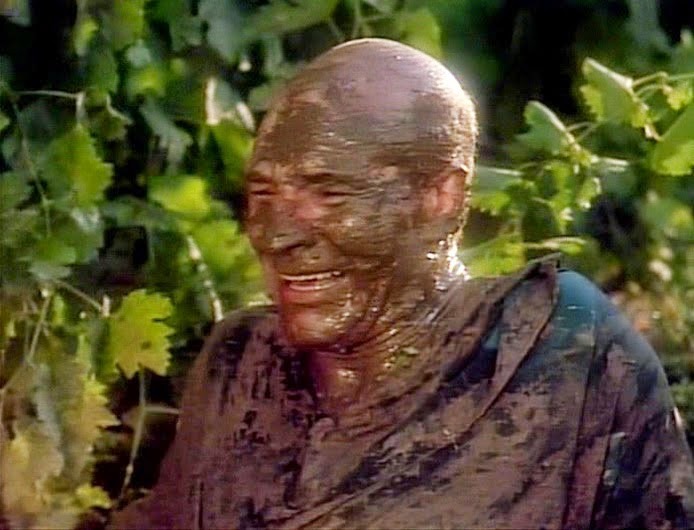
him to be used to kill thousands of people against his will. Eventually the two
brothers have a fight in the mud and Picard has a bit of an emotional
breakdown, it all comes out, the two reconcile and Picard returns to his job
having addressed the trauma and acknowledged that it’s something he will now
always have to live with. Sounds like a good episode right? Not according to
Gene Roddenberry. Ronald D Moore who wrote this one, and many other great
episodes recalls:
"Gene goes through this whole thing about how much
he hates this script. 'It says terrible things about Picard’s parents; these
brothers don’t exist in the twenty-fourth century; they have such profound
personal animosities; this would never happen. I don’t buy any of this, this is
not a Star Trek episode. There’s no action in this; there’s no jeopardy. We can’t
do this show.'" After the meeting, Executive Producers Michael Piller and Rick Berman advised Moore to finish the script anyway, and that they would deal with
Roddenberry. Moore concluded, "I went off and wrote it, and never heard
another word. Somehow, they were then dealing with Gene in a different way and
that script just went through after that point. He just stopped kind of
throwing out scripts and changing things from that point forward, and just
started slowly to change.”
See now it kind of feels like Gene Roddenberry vision might be getting in the way of good stories and a new team of executives had to step in. Does that make them wrong and Gene right?
Even more surprisingly what Gene Roddenberry hated: Star
Trek II: The Wrath of Kahn. That’s right. Almost universally regarded as the
best Star Trek film ever made. Oh sure you’ll find some people like me who
think First Contact is better – indeed any film where Patrick Stewart wears a
tuxedo and machine guns down a bunch of zombie robots is better than any in which that
doesn’t happen. Casablanca is great but Patrick Stewart doesn’t machine gun
down a bunch of zombie robots while wearing a tuxedo so it’s not perfect. But
anyway The Wrath of Khan is basically considered by most to be the best ever
Star Trek movie. Gene Roddenberry complained mainly about the militarism in the
movie. But more interesting than that in terms of sticking to what Gene
Roddenberry believed, he was basically not allowed to write this movie.
Apparently he’d been such a nightmare on The Motion Picture, which is an
interesting movie that goes to some deep places but has also been dubbed The
Motionless Picture and been described as slow and boring, that he was basically
made an Executive Consultant on the subsequent Star Trek movies. Essentially that
means he was paid a lot of money to stay out of things, he could read and offer
advice on scripts but the writers and producers were under no obligation to pay
any attention to him. Now for the record he made some good suggestions that the
team went with and some that they ignored. But the fact remains that arguably
the best Star Trek film ever was made by pushing Gene Roddenberry out of the
writers room and almost out of production entirely.
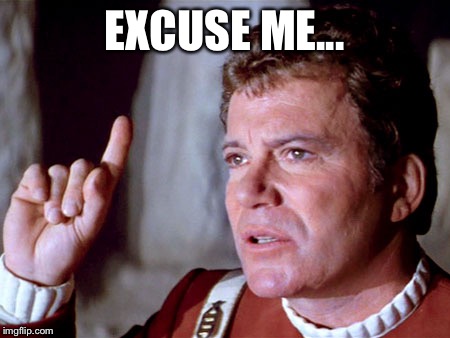
And for the record Mr Shatner, he also was not a big fan of Star Trek V: The Final Frontier which Shatner wrote and directed, though that’s less of a bombshell because it’s not so well liked. Though if Patrick Stewart shooting Robot Zombies elevates any great movie to perfection, William Shatner innocently asking “Excuse me but, What does God need with a star ship?” might be able to save even the worst film from being truly awful. You can’t tell me it wouldn’t have made The Human Centipede or A Serbian Film at least a little bit more enjoyable.
So all that being said, the question now is: does it matter
that Gene Roddenberry would be turning in his grave? And honestly, I think not.

There’s something in what William Shatner said that I think hasn’t been properly addressed. When he said “Gene Roddenberry would be spinning in his grave.” One thing that nobody seems to have noticed in what Shatner said. Gene Roddenberry is in his grave. He dead! Sorry to break it to you.
I’m from a place called Welwyn Garden City, it was founded by Ebenezer Howard in 1920 to be the perfect utopian town. Now there is an empty building long since abandoned by whatever it used to be opposite a beautiful looking fountain and with great views of the grassy nature filled town centre – I am going somewhere with this I promise – that building has been purchased by a pub company who tried to get permission to open a pub in it. But have been met with opposition from local groups in part because opening a pub there was not in keeping with the original intentions of Ebenezer Howard. So I live there now but I can’t have cheap beer because a man who died in 1928 wouldn’t approve? Does that seem right. Things have moved on Ebby!
The same is kinda true here. Gene’s dead. We can’t just keep
copying what he was making in the 1960s, we have to move on.

Gene Roddenberry’s legacy isn’t that he wrote a TV show. A
lot of people can do that. And we’re not here discussing whether the twelfth spin-off is true to the original spirit of Z-Cars. Gene Roddenberry’s legacy is
that he inspired a lot of other writers and creatives to share their take on
his vision. The show doesn’t – and never has – belonged to one person.
We also need to stop talking about Gene Roddenberry like he
was some kind of God-like infallible being. You know what was in Gene Roddenberry’s
vision? Denna Troi should have three boobs. And it was only after every woman
around him told him what an awful idea that was that it was dropped. The point
is Gene Roddenberry’s vision is mostly great. But what’s made Star Trek one of
the best shows on TV has been collaboration and listening to new ideas when it
needed to.
Claiming that Gene Roddenberry doesn’t like Star Trek now
has been a common criticism on the internet. I guess people think that you
might argue with someone in their bedroom who doesn’t like the series led by a
black woman but would anyone write 3000 words disagreeing with Gene Roddenberry
– probably not.
If you don’t like new Star Trek that’s fine. There are fair
criticisms of it – infinite lifts! – but I think it’s time we moved passed what
one man thinks. Tell me your opinion. Don't hide behind pretending you know what Gene Roddenberry thinks. That's not relevant to what you think.